 What if a couple of winemakers were up drinking late one night and concocted an idea to create an underground museum to celebrate the making of wine, where tourists would walk through the museum from the perspective of being a grape?
And what if the same two fellows roped architect Steven Holl from New York into designing a hotel for the museum, which he repeatedly refused to design, but after a bunch of wine Steven had sketched the hotel on a cocktail napkin before dawn? Meet the Loisium (loy-zee-um). It’s an interactive tour of wine, a museum of Austrian wine making history and a deluxe ultra modern hotel/spa. I got to stay there for two nights!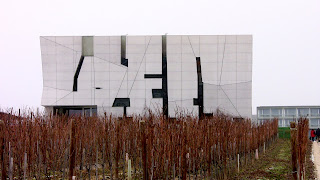 Located in Langenlois, Austria, the museum was built first. The problem was that: A) it was underground; invisible to tourists and B) there was no place to stay. So the vision to build a hotel and include the Aveda wine spa came to life. The museum’s welcome center and gift area has no regular windows and not a single 90 degree, true angle. The hotel won a major architectural award for its design. All I can say is you have to see it to believe it.
  Mostly concrete with heated floors, the hidden bathroom, and the room service just for your bed comfort are fantastic. You can order a special pillow, a different mattress, various comforters, you name it, they accommodate. The breakfast was outstanding and I found one of my favorite food signs ever on the buffet.
With Mr. Karl Steininger of Steininger wines as our host, we got to know the late night/early morning crowd at the Loisium both evenings. His long drinking session reputation preceded him and we were warned. The second evening I went to sleep in the low digit morning hours, but several of the group never went to sleep and continued on with Karl tasting each and every barrel of wine in the cellars. Once you have tried your 11th tank of 2008 Gruner Veltliner, it’s a little difficult to taste
 tle. [I hope to finish a video for you in the next month showing the process.] This was followed by a seven course dinner prepared by Brigetta and Leeza with seven different Sekts for each plate. One of my culianary/wine lifetime highlights will forever be the 2006 Sekt Cabernet Rosé paired with smoked trout and horseradish cream.
The family produces their Sekt only in the best of vintages and ages the bubbles for an extended period in the barrel or tank, then on the lees for just 1 year in the bottle. Karl explains that his preference is to “ taste the wine in the sparkling wine” and not the yeasty quality. They produce a vintage “Grand Cru” only in magnum and hand sign each bottle. The base wine is aged for four years in 2,000 Liter wood barrels made from local forest wood. At the Loisium bar we must have downed 4 or 5 magnums our first night. I knew it was good, but didn’t realize...
 In between our time at the Loisium and the Steiningers, we snuck away to the Wachau region to walk the terraces with Martin Mittelbach of Tegernseerhof estate. It’s wicked cold as we depart the bus and Martin marches us up the hillside into the vines. Seeing the hills, the
Located in Langenlois, Austria, the museum was built first. The problem was that: A) it was underground; invisible to tourists and B) there was no place to stay. So the vision to build a hotel and include the Aveda wine spa came to life. The museum’s welcome center and gift area has no regular windows and not a single 90 degree, true angle. The hotel won a major architectural award for its design. All I can say is you have to see it to believe it. Mostly concrete with heated floors, the hidden bathroom, and the room service just for your bed comfort are fantastic. You can order a special pillow, a different mattress, various comforters, you name it, they accommodate. The breakfast was outstanding and I found one of my favorite food signs ever on the buffet. With Mr. Karl Steininger of Steininger wines as our host, we got to know the late night/early morning crowd at the Loisium both evenings. His long drinking session reputation preceded him and we were warned. The second evening I went to sleep in the low digit morning hours, but several of the group never went to sleep and continued on with Karl tasting each and every barrel of wine in the cellars. Once you have tried your 11th tank of 2008 Gruner Veltliner, it’s a little difficult to taste
how it is different from the first 10 tanks. These guys weren’t even close to hungover yet. That would come around 3 PM that afternoon once the alcohol wore off. In time we came to be very fond of the entire Steininger family. There were the daughters Ana, focusing on the red wine production, Eva who focuses on white wines, and Leeza who was the youngest daughter and still learning everything. We met Brigetta, the matriarch and the always jovial Karl. The Steininger estate not only makes great reds and whites, but also focuses on Sekt sparkling wine production in the Champagne method. We were treated to watching the disgorgement process and each of us allowed to finish a bottle of Sekt on the bottling line so that we could take home our very own personal bot
tle. [I hope to finish a video for you in the next month showing the process.] This was followed by a seven course dinner prepared by Brigetta and Leeza with seven different Sekts for each plate. One of my culianary/wine lifetime highlights will forever be the 2006 Sekt Cabernet Rosé paired with smoked trout and horseradish cream.The family produces their Sekt only in the best of vintages and ages the bubbles for an extended period in the barrel or tank, then on the lees for just 1 year in the bottle. Karl explains that his preference is to “
taste the wine in the sparkling wine” and not the yeasty quality. They produce a vintage “Grand Cru” only in magnum and hand sign each bottle. The base wine is aged for four years in 2,000 Liter wood barrels made from local forest wood. At the Loisium bar we must have downed 4 or 5 magnums our first night. I knew it was good, but didn’t realize...In between our time at the Loisium and the Steiningers, we snuck away to the Wachau region to walk the terraces with Martin Mittelbach of Tegernseerhof estate. It’s wicked cold as we depart the bus and Martin marches us up the hillside into the vines. Seeing the hills, the terraces and all the surroundings, we now feel like we have seen both spectrums of Austrian vineyards. From flat to mountainous, this area has traditional stone walls surrounding special vineyards similar to Burgundy, France. Each “clos” carries significant meaning and often a price. This is some of the top Austrian wine in the world all around us. When we drive to the Mittelbach house, we cross the Danube river which has frozen in places. Martin says this hasn’t happened since 1986. We meet the father, Frankl, who now watches over the family operations, along with his mother Dita and sister Eva in a house that was former monastery.
 Back in 1970 Frankl produced straight forward wines, but today Martin has taken the winery to new heights using spontaneous fermentations, bigger extracts, later harvests and innovative winemaking. The house is set up for us with tasting stations in each room. We are welcomed by tasting single grand cru vineyard wines from various vintages at each stop. As we go around the rooms, Martin tells us about the rainfall that year, how the harvest went, what happened during the fermentation and how he feels the vintage is aging. Tasting white wines from 2001, 2003, etc we are seeing that these austere, minerally whites are just babies, but aging wonderfully.
 We sit down for a formal tasting of new vintage wines and eat some of the best bread I have ever had. I can’t stop eating the basket of rolls. Klaus Wittauer is obsessed with a video promoting Austria and he literally comes to tears as we watch it for the fifth or sixth time. I admire his passion for the homeland and the video is great to watch (see below). After a dozen or more wines, it’s time for lunch. In a beautiful setting complete with candle
 s and fine dining catering, under a giant antique wine press, we dine and drink the great Tegernseerhof wines. Martin is young and ambitious. He has brought on an assitant, Annika, to help make wine so he can pursue his ideas in the vineyards. As much as I enjoyed the wines, I am left wondering if customers are ready to pay for a single vineyard “Steinertal” Riesling 2002 from Austria. Baby steps, baby steps. For now we’ll stick to the T26 Gruner Veltliner and his rosé, both coming this spring. - Salamanzar
Back in 1970 Frankl produced straight forward wines, but today Martin has taken the winery to new heights using spontaneous fermentations, bigger extracts, later harvests and innovative winemaking. The house is set up for us with tasting stations in each room. We are welcomed by tasting single grand cru vineyard wines from various vintages at each stop. As we go around the rooms, Martin tells us about the rainfall that year, how the harvest went, what happened during the fermentation and how he feels the vintage is aging. Tasting white wines from 2001, 2003, etc we are seeing that these austere, minerally whites are just babies, but aging wonderfully.We sit down for a formal tasting of new vintage wines and eat some of the best bread I have ever had. I can’t stop eating the basket of rolls. Klaus Wittauer is obsessed with a video promoting Austria and he literally comes to tears as we watch it for the fifth or sixth time. I admire his passion for the homeland and the video is great to watch (see below). After a dozen or more wines, it’s time for lunch. In a beautiful setting complete with candles and fine dining catering, under a giant antique wine press, we dine and drink the great Tegernseerhof wines. Martin is young and ambitious. He has brought on an assitant, Annika, to help make wine so he can pursue his ideas in the vineyards. As much as I enjoyed the wines, I am left wondering if customers are ready to pay for a single vineyard “Steinertal” Riesling 2002 from Austria. Baby steps, baby steps. For now we’ll stick to the T26 Gruner Veltliner and his rosé, both coming this spring. - Salamanzar

 earth we see bits of both under foot. Inside we warm up with a little of Leo’s sparkling Secco which is a dry Pinot Noir Sekt (sparkling wine). The color is a dreamy pink and this is one we have sold back home in Durham very well. The good news? The price is going down and we will now be able to sell this for $15.99 per bottle. A steal when it arrives in March.
 We have a leisurely morning and then we are off to Wagram to meet Mr. Anton “Tony” Bauer, man of mystery. The winery is a short walk from the main road and we come to a rather subtle cellar as compared to the high fashion wineries we visited so far. The cellar walls have a thick black mold like shag carpet. Visitors have pressed euro coins into the walls for “good luck.” But if you ask me, Tony is saving the Euros to build a new


 elfth vintage of course, and the Wagram Reserve (Cab/Syrah/Merlot/Zweigelt blend) I find myself with the same stunned feeling. I am quiet and smiling inside. If anyone asks, I’ll say my glow is the alcohol’s affect. The real test of these wines is yet to come as Tony is taking all of us to Toni Mörwold’s restaurant for dinner. Chef Toni is the “Emeril Lagasse” of Austria, complete with his own TV show and fine dining
  eated to an Amuse Bouche of baby greens with Foie Gras. And it’s a good thing because my Foie intake on this trip was getting low. Tony Bauer arrives with his beautiful golden retriever named Sammy after his favorite actor Samuel L. Ja
 ckson. Sammy even joins us on the floor during dinner. The first course is a foamy Gruner Veltliner cream soup with a cracker thin slice of fried bread floating in the middle. As I finish my bowl I quickly scanned the table to see if anyone was not finishing theirs. No luck. I seriously tried to order 10 gallons to take back to the US, but I am told it won’t make it through customs. This is absolutely one of the best soups I have ever tried and as much as I love soup, rarely do I rave about the dish. The 2004, 2005 and 2006 vintages of the Gruner Veltliner Grande Reserve are served beside the soup. Yes, they are still oaky, and yes the wines are a perfect match for this dish. I am in awe. Not only are they great, but the 2004 (the oldest vintage) is the perfect wine at this moment. I still can’t believe it. [I have ordered some Grande Reserve to arrive in March. I think Craig thought I was crazy for ordering an expensive, oak-aged Gruner. We’ll see what he says when he tastes it this spring. I could be in big trouble. Please be sure to try this one out, there will be very little available.] We are told the meal is ha
 lting for a special break and asked to leave the room. As we file into the adjoining banquet room, we see it is a makeshift movie theater. Tony Bauer debuts his newest short film called “Private Selection.” Tony made the film just for fun and to show off his rarest of all wines. You can watch the movie


 ocess. Stirring the lees adds richness to the finished bottle and a distinct character. The group is ready for more wine and we start with his dry whites. The Chardonnay we sample is a proud moment for Ernst as he claims it is being compared to the finest of white Burgundy. All his dry wines, white and red, are excellent, but we are anticipating the sweet stuff and finally the traditional tall, thin 375 ml bottles emerge. We work through them with ooohs and aaaahs. It’s tough to spit these, so I force myself to swallow the tastes justifying that I have worked hard today and could use a little reward this time. The excitement in the group grows with each opened bottle, then the talk of Steindorfer’s “best wine he ever made” starts up. Klaus is egging him on and we join in. Finally Ernst either felt gen
 erous, or the wine was kicking in, but he goes to the cellar and emerges with his 1991 Trockenbeeren Auslese (TBA), the claimed "best ever." The color is a deep amber and pours from the bottles like a watery version of maple syrup. I am practically intoxicated just by smelling the aroma. I take a picture through the glass with the label behind the bottle. A fine finish to our visit at Steindorfer.
 o Hillinger’s winery for an introduction, tour and dinner. This is just the start. The
 real tastings will take place tomorrow. We arrive at an ultra fancy shmancy modern looking winery established by Leo Hillinger, former super-model and now wine maker/wine fashion superstar. If anyone knows how to build a brand, it’s Leo. With things like the Hillinger name everywhere from the
 entrance to the floor of the winery, to the continually running video loop of Leo projected on the wall, to the slick black hats, several hundred dollar Hillinger jackets, you name it, Leo is creating it with his name on it. Leo is opening Hillinger wine shops in Europe and wants to have one in NY as well. Several women in the group nearly faint when they first see Leo in real life. Sure has more hair than me, it’s blonde and he is tall, square jawed, thin and owns a top winery, but really does he deserve all the gawking? It must be tough for him. By the way he is married with two beautiful children.
 asting room has a glass wall looking out over the vineyards behind the hill.
 mercy of mother nature every harvest. We can tease him about the glamour aspect of his winery and its presentation, but clearly the wine is quality while he can smile all the way to the bank. Leo is focused on building the Hillinger brand.
  in. Good stuff, sweet and spicy. The actual meal takes about 45 minutes, then the consumption began. I think we left around midnight or 1 AM. Not sure, but by the end we had empty magnums of wine lining the table. Half the group goes out to the Safari club. Don't ask, but if you are ever in town and want to meet the locals, ask about the Safari. We'll be back tomorrow to learn more.
 waves topple boats. Between rows of perfectly manicured vines on both sides, the Graupert vineyard stands out like a punk rock spiked mohawk on the set to Leave it Beaver. In a deep spiritual moment with his vines, Werner Jr. thought that if he lets the vines go wild, eventually they will become self-limiting and reduce the stress of pruning each year which was hurting the vines. Essentially, if left to grow wild the grapes will be better. And you know what? It’s working. The vines unkempt look are criticized by his neighbors and he is accused of being lazy. In fact, last year some locals set fire to part of the Graupert vineyard to make their point. The proof is in the bottle and the Meinklangs remain committed. And, there is talk of letting all their vines grow Graupert style. Oy, the potential bonfire! You will see some Graupert Pinot Gris coming to Wine Authorities this spring.
 riculture and children running around growing up on the farm paints a Rockwell-esque picture. With each family member taking on specific responsibilities, the farm is complete and each area is dependent on the next. This family, the parents, the three sons, their wives and the grandchildren, are organic, natural, down to earth, and clearly have found their happy place. There is an energy and a harmony in the air. You can taste it. Okay, I am ready to start packing the bags.
 hich are packed with manure and aged before being mixed with water to spread in the fields. The farmers refer to this stuff as “magic poo.”
 mpared to their other wine making techniques. We taste the “Konkret St. Laurent,” and this is the best St. Laurent wine I have ever had, hands down. I am a believer. They started with a couple of eggs and now the winery looks like a chicken coop. The good news is that you can adopt an egg for just 3,000 Euros which gets you 2 cases of wine per year from your egg, over 10 years. That’s a deal!
 a part of this family farm. It speaks to my soul. The bus ride is quiet all they way to the the next winery. I clutch my Meinklang micro brew and savor every sip. Can we replicate this in Durham? Someone is probably ahead of me already. Meinklang will become a great addition to our store. They fit right in with us. Steindorfer winery awaits the whale’s arrival.
 Our bus driver, Christian, speaks no English and this is his fourth trip with Klaus touring Austrian wineries. In time we get to know Christian and even with the language barrier, he is a nice guy and clearly a talented driver as he guides our behemoth through small passes and around mountain vineyards. Christian lands the great white whale at our first stop, Netzl winery in Burgenland.


 t one story of an inappropriate traveler on one of these trips who came because they thought it was drink-fest. No, this trip we all have our pens, notebooks, cameras and lots of questions firing away all day long. After lunch we head to Michlits/Meinklang winery to see “the eggs.”
  So I will no longer date the entries, but just label them as parts. Okay, I feel better now.
 reflecting the warmth by night. These things are often talked about when discussing great vineyards and the vine’s ability to ripen the fruit. The pictures here show snow covered land and then the famous Doctor vineyard in Bernkastle behind the church, see? No snow.
 macorc because he says after about 5 years the plastic corks are loosing resiliency and becoming loose in the bottle necks. Before we leave, FK asks me for a recommendation in bottling his 2008 Hipping vineyard Spätlese. I am sort of awestruck as I think, who am I to tell YOU what to do. The question is, how much of the 2008 vintage should he bottle as a truly dry wine and how much to bottle with some residual sweetness?

 The 2007 vintage in the Rheingau was challenging. Many farmers were fearful of rains coming and ruining the vintage, so they picked early, too early, leaving too much acid and unripe flavors in their wines. Molitor, waiting until late October for physiological ripeness, achieved great flavors and balanced wines. It was risky, but worked. One of the tasting highlights is a Riesling Trocken, Edition René. I am hoping we can bring this to the US market exclusively.
 this will do just fine. I guess I missed the word Béarnaise in her German accent, something I would normally pass on for health reasons. I am treated to the most juicy pork cutlet with sautéed onions and ham, smothered in tarragon herbed Hollandaise sauce. My cholesterol surely shot up 100 points that night and Derek politely watched me all but lick the plate.
 Derek drops me back in Frankfurt at the airport, and I leave for Austria that evening.